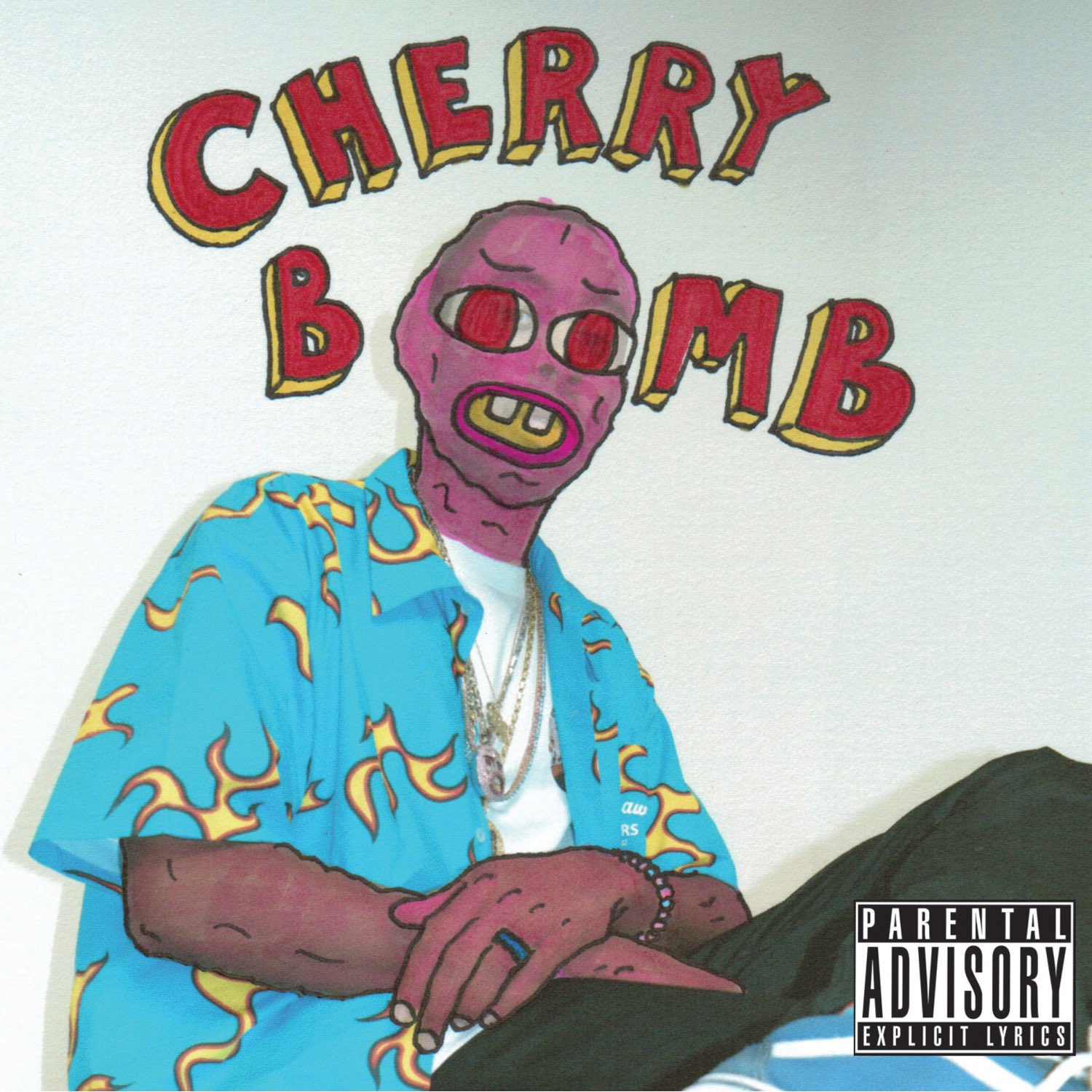
Tyler’s fourth studio album sounded nothing like his previous work leaving many fans torn. Less gritty and graphic than Bastard, Golbin and Wolf, Cherry Bomb still stands out as the Grammy-winning artist’s most ambitious project. Cherry Bomb’s release was immediately met with mixed reviews and still has the fan base split on if this is his worst project or one of his bests.
While the masses are split on how high Cherry Bomb sits amongst his albums. Seven years since its divisive release, Cherry Bomb could sit as Tyler’s most important album to date.
While unique, Tyler’s first two albums maintain a similar gritty sound not offering much crazily outside of the realm of the other. Looking for a different sound in 2016, Tyler started heavily using synths which would soon become a staple.
Lyrically Tyler evolved also, while his first three-album run largely focused on his fictional character Wolf Haley, Cherry Bomb offered a different look into Tyler’s life as he transitions into rapping about how he’s built his career and the different challenges that come with that. Tyler continues to build his storytelling abilities, but as much of the album, it is more abstract than past work.
The start of the album is much much more chaotic with a gritty sound reminiscent of his early work. As the album progresses it almost seems like a progression of Tyler’s career. After the gritty in-your-face start of the album, Tyler drastically changes the tone while showing off his production chops with songs like ‘2Seater,’ ‘Fucking young/Perfect’ and ‘Smuckers.’
Songs like ‘2Seater’ show Tyler’s growth as an artist, as he paints a picture of him and his girl taking a ride. Tyler mixes drums with a fuzzy synth while he took listeners on a trip down a road detailing his career and the journey he’s been on.
While Cherry Bomb’s drastic changing landscape throws people off, Tyler’s experimental album helped establish his diverse production album style that began to shine through to the mainstream with his follow-up effort ‘Flower Boy.’
Tyler’s ear for sampling begins to thrive as the California emcee taps into a wide variety of genres including blues, R&B, jazz and went as far back to sample to the 1800s with samples of The Traditional Folks’ ‘Peter Piper’ and ‘Eenie, Minnie, Moe’ for the albums second track ‘Buffaloe.’
Despite the mainstream not finding the appeal to Tyler’s fourth project, they would soon the often misunderstood Sir Baudelaire. ‘Flower Boy’ earned Tyler’s first nod for Rap Album of the Year at the Grammy’s. This follow-up was an immediate critical and commercial success possibly surprising those who were hesitant after ‘Cherry Bomb’ flopped.
While the influence from ‘Cherry Bomb’ may not be outright apparent to some, it marked a turning point in his sound. Tyler established his own sound that few can replicate introducing an airy sound that often bends genres with fluid melodies with the backbones of rap.
Possibly the closest things fans have gotten to a follow-up to ‘Cherry Bomb’ lies in Tyler’s most recent project ‘Call Me if you Get Lost.’ After back-to-back albums that saw Tyler shift to a more pop approach for most of the projects, Tyler returned to his roots with a rap on CMIYGL. Back to spitting bars, CMIYGL sounds like a mature ‘Cherry Bomb’ with a variety of beats that range from complex to simple melodies.
While many fans are still torn on Tyler’s fourth album, seven years later it proves to be an underrated masterpiece hidden in Tyler’s deep discography.
 Musically Sound Media